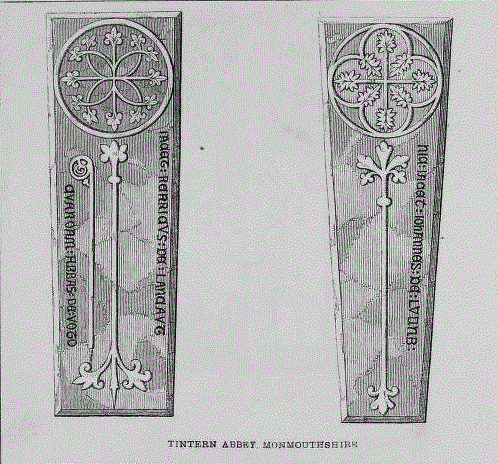
The Cross Slab of Henry of Lancaut and Thomas de Lyuns1
The cross slabs illustrated above were in fact one slab which originally lay at the foot of the steps leading from the north cloister into the cross isle of the church at the Cistercian abbey at Tintern in Monmouthshire.2 The slab has now been moved to an open air storage area.3 Reading from left to right, it once marked the place of burial of Henry de Lancaut and Thomas de Lyuns. There are two separate illustrations of the slab made by Rev John Skinner in 1832 which may be found in British Library Add MS 33725.4
Henry was a monk at Tintern in Monmouthshire before being appointed as the third abbot of Tintern de Voto in Wexford, a daughter house of Tintern. After he retired as abbot of de Voto he returned to Tintern where he died about 1250. The deserted medieval village of Lancaut (Welsh: Llan Cewydd) where he was presumably born is situated directly south of Tintern but on the Gloucestershire side of the Wye valley.
Henry’s part of the raised cross slab depicts a graceful floriated cross and bears the legend [Hic] iacet Henricus de Lancaut ([Here] lies Henry of Lancaut). To the left of the cross is a bishop’s pastoral staff in the form of a shepherd’s crook turned outwards to symbolically embrace the second part of the legend Quondam abbas de voto (Once the abbot of de Voto). The cross is a symbol of Henry’s faith. At its head is a nimbus enclosing a stylised quatrefoil cross formed from vines terminating in leaves; the whole composition pointing to his belief in the triumph of Christ over death.5
Thomas’ adjacent slab depicts an equally elegant cross in a similar style, the legend of which reads Hic iacet Johannes de Lyuns (Here lies Thomas de Lyuns). There is no abbot’s pastoral staff although the style and inscription is similar to Henry’s, suggesting that although John was not an abbot he was probably a senior monk who died at Tintern. The single slab suggests that they died at or about the same time.
Further research into Thomas’ background might reveal evidence of his date of death and his association with either de Voto or Tintern thus helping to provide a more accurate date of Henry’s death. It was quite common for abbots and monks to act as envoys and though it may be a coincidence John de Lyuns and Robert of Warleye acted as the King’s messengers to Ireland in 1258.6
References:
- E.L. Cutts, A manual for the study of the sepulchral slabs and crosses of the middle ages (London: J.H. Parker, 1849), Plate LXI
- Charles Heath, Historical and Descriptive Accounts of the Ancient and Present State of Tintern Abbey (London: Longman and Company, 1828); L. Butler, ‘Cistercian Abbots’ Tombs and Abbey Seals’ in Studies in Cistercian Art and Architecture, ed. M P Lillich, vol. 4, (Kalamazoo: Cistercian Publications, 1993), pp.83 and 246
- Professor Madelaine Gray, University of South Wales, personal observation
- Charterhouse Environs Research Team, Introduction to the ‘CHERT’ Index of the Drawings and Sketches of the Reverend John Skinner, 2012 Index Vol 107 volume 107 at pages 272 and 273 illustrations numbered 46 and 60.
- Sic enim Deus dilexit mundum, ut Filium suum unigenitum daret: ut omnis qui credit in eum, non pereat, sed habeat vitam aeternam. ‘For God so loved the world, as to give his only begotten Son; that whosoever believeth in him, may not perish, but may have life everlasting’. (John 3.16}
- Calendar of Documents Ireland 1252-1284, (ed.) H.S. Sweetman (London: Longman & Co, 1877), p.96
 The Tintern de Voto Research Project