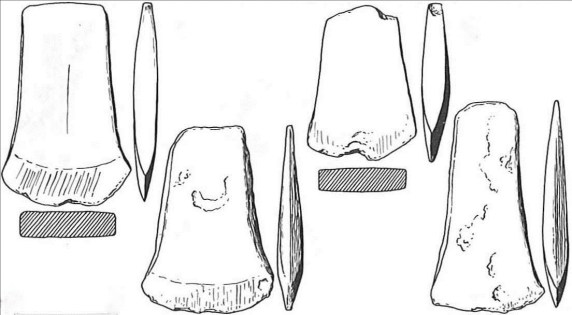
Copper axe heads from a hoard at Carrickshedoge, Nash, Wexford.1
National Archaeological Museum, Dublin). Scale I: 3.
The modern place name:
Carrickshedoge, Nash, County Wexford
Etymology of the place name:
The name derives from the Gaeilge Carraig Shéideog suggesting that it is an area of rocky ground subject to gusts of wind.
Co-ordinates:
Latitude 52.33287852 Longititude -6.8557374
Elevation:
Height above sea level: 47.25m (155ft).
National Monument Number:
WX035-047—- (uncategorised natural feature)
Site Description:
It is described in the official record of monuments and places as a ‘sub-rectangular field (dimensions 57m N-S; 54m E-W) defined by a stone wall (width 0.7m; height 0.5m) at the north and earthen banks (width 3m; height 1.2m) elsewhere’. It is ‘located on an east-facing slope’ with the Owenduff River running N-S approximately 300m to the east’.1
Connection with Tintern de Voto:
At the time of the survey of Tintern de Voto in 1541 following its dissolution, its landholdings included 120 acres of cultivatable land and an unspecified area of land lying waste in Nash and Gayneston.1 Most probably it was once part of the ‘land that belonged to Meiler the serjeant to the west of Ananduf (Owenduff).2 Nash lies to the south-east of the modern townland of Mylerspark and to the west of the Owenduff. The site is approximately 16km or 10 miles north of Tintern de Voto.
The Hoard:
In January 1925, ‘a workman employed in taking out stone on Mr. Fowler’s farm at Carrickshedoge, in the townland of Nash, Barony of Shelburne, Co. Wexford, came upon a cave’ near a spring well ’of which he had no previous knowledge. About four feet within the entrance on a shelf of rock he found four copper axes’, a cake of copper and two smaller fragments.4 Bremer dated the find to 2500 BCE. He also suggested that the copper may have come from the Bunmahon copper deposits in County Waterford about twenty miles south of Carrickshedoge. Of the four axes, one is of the Lough Ravel type whilst two are of the Ballybeg kind supporting Bremer’s dating of the hoard.6 Other artefacts such as moulds, punches and polishing stones, were not recorded as finds. It is an open question as to whether the hoard was deliberately left in the cave by the coppersmith or left there for a symbolic or ritual purpose.
References:
1. H.J. Case, ‘Were Beaker-people the First Metallurgists in Ireland?’, Palaeohistoria, Vol. XII, p.152, 1966
2. Record of Monument and Places, Archaeological Survey of Ireland, record number WX035-047—-
3. White, N.B., Extents of Irish Monastic Possessions 1540-1541 (Dublin: Irish Manuscripts Commission, 1943), p.359
4. Irish Records Commission, 1829-30, ‘CPI80’, privilegia et immunitates, being transcripts of charters and privileges to cities, towns, and other bodies corporate, […] 1171–1395 (Dublin: Irish Records Commission, 1889), p.80
5. W. Bremer, ‘A founder’s hoard of the Copper Age at Carrickshedoge, Nash, Co. Wexford’, The Journal of the Royal Society of Antiquaries of Ireland, Ser. 6, Vol. XVI, pp. 88-91, 1926
6. Harbison, P. ‘The Axes of the Early Bronze Age in Ireland’, Prahistorische Bronzefunde IX (1). 1969
 The Tintern de Voto Research Project